
The next two days, on this south of France journey, we ventured into two more natural caves that had been open to the air for thousands of years. Like Font-de-Gaume, the caves were preserved as much as possible, once their significance was realized, with minimal lighting used sparingly and floor gratings to protect gravel and stone paths. Tour guides were equipped with laser pointers to designate the outlines of the paintings and etchings.
Note: I didn’t take photos in the caves. The following images are from Wikimedia Commons, an Internet source of photos in the public domain.
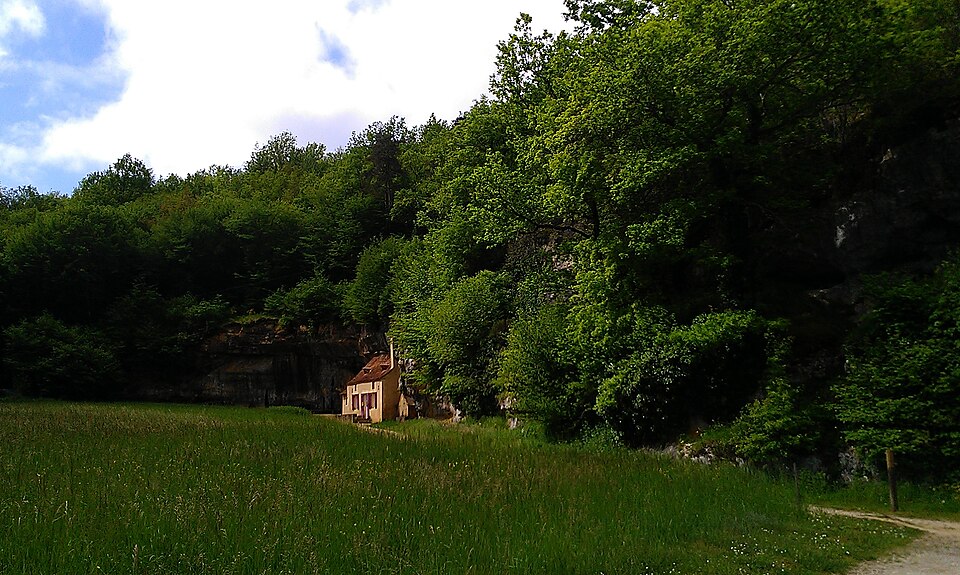
Les Combarelles
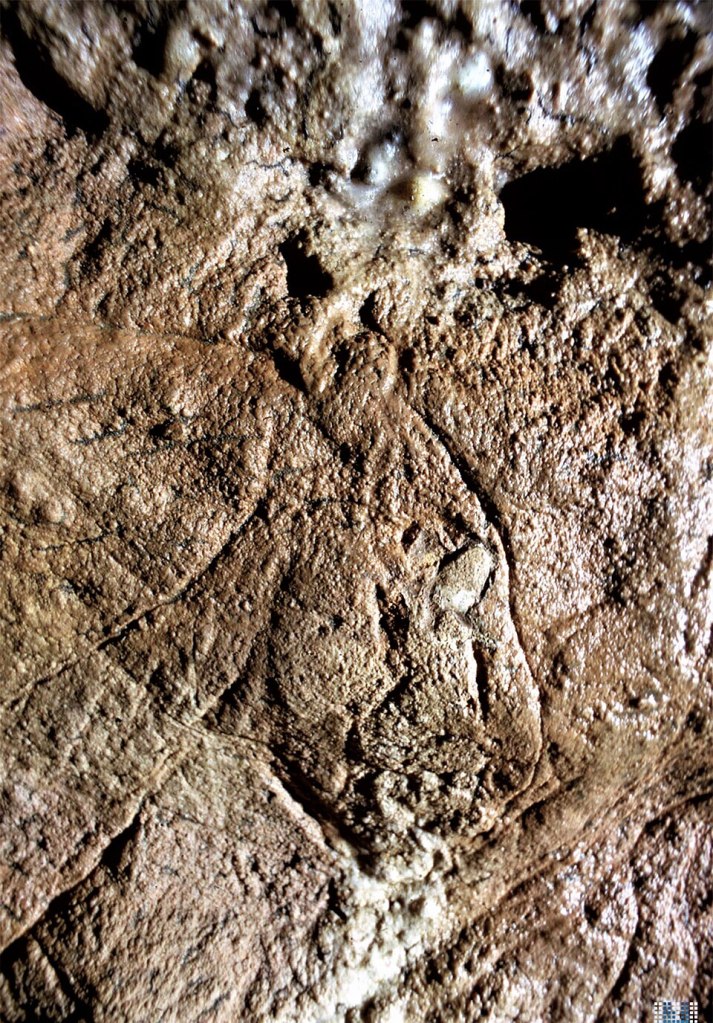
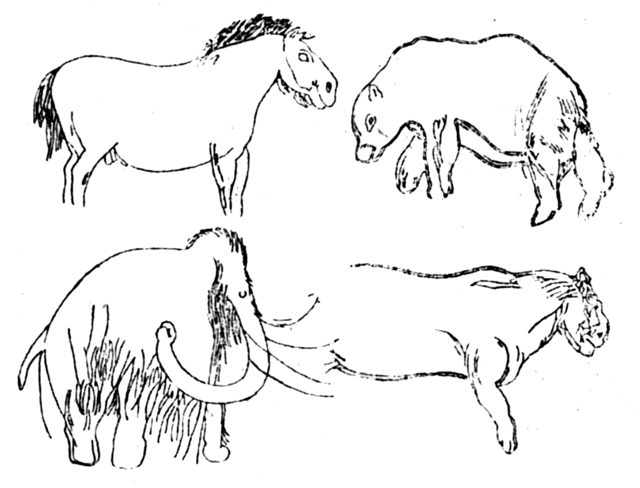
The two galleries in Les Combarelles have over 600 instances of Magdalenian engravings, from around 13,000 years ago. The cave was used as a stable by locals who found artifacts, but was not explored by pre-historians until 1901. It has been recognized as a UNESCO World Heritage Site as part of the Prehistoric Sites and Decorated Caves of the Vézère Valley. The drawings below were made by Abbé Henri Breuil.




Pech-Merle
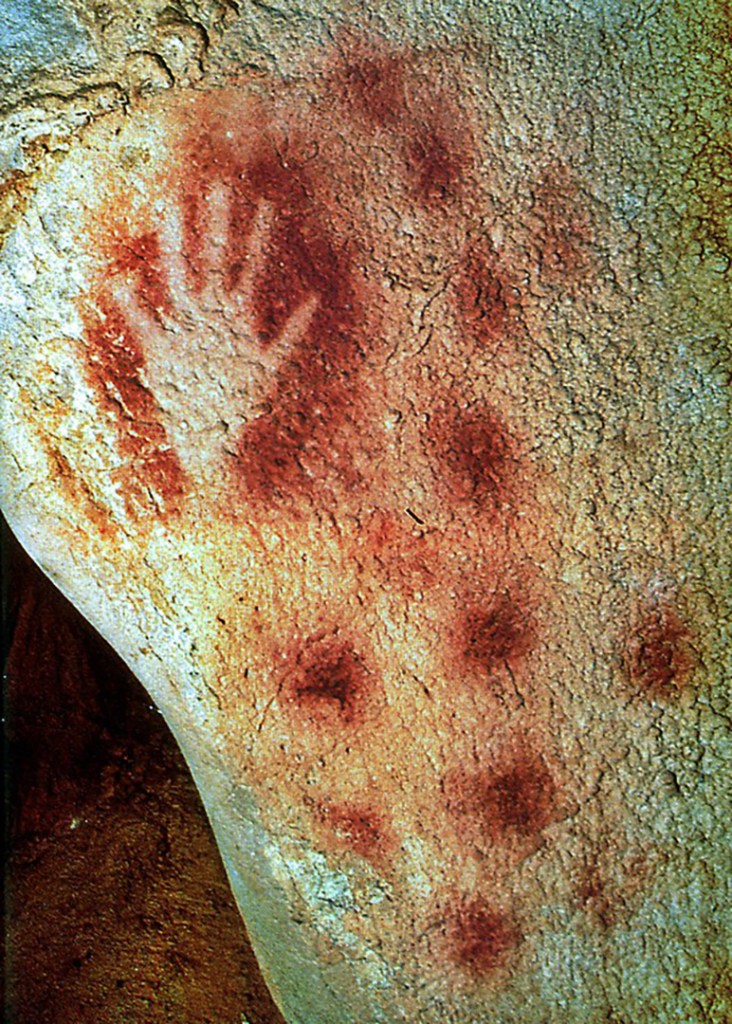
Formed by an underground river, Pech-Merle cave covers two levels. The cave art appears in the deeper areas, discovered in 1922 by exploring local teens. It has been open to the public since 1926. As well as paintings and etchings of animals, including the beautiful dappled horses, there are many stenciled human handprints, dots and other symbols. There were also a few stick-figure drawings of humans with lines coming out of them, possibly speared, referred to in the literature as a “killed man”. Footprints of children were found preserved in rock that was once clay.
Paintings and engravings have been dated from 27,000 years ago, the Gravettian era, although some may date from 14,000 years ago, the Magdalenian period. The cave was declared a French Historical Monument in 1952. The museum shows videos of additional images in inaccessible areas inside the cave.
How moving it was to hold up one’s hand, without actually touching, of course, to the hand of a prehistoric artist, probably the hand that created some of the art in this cave!

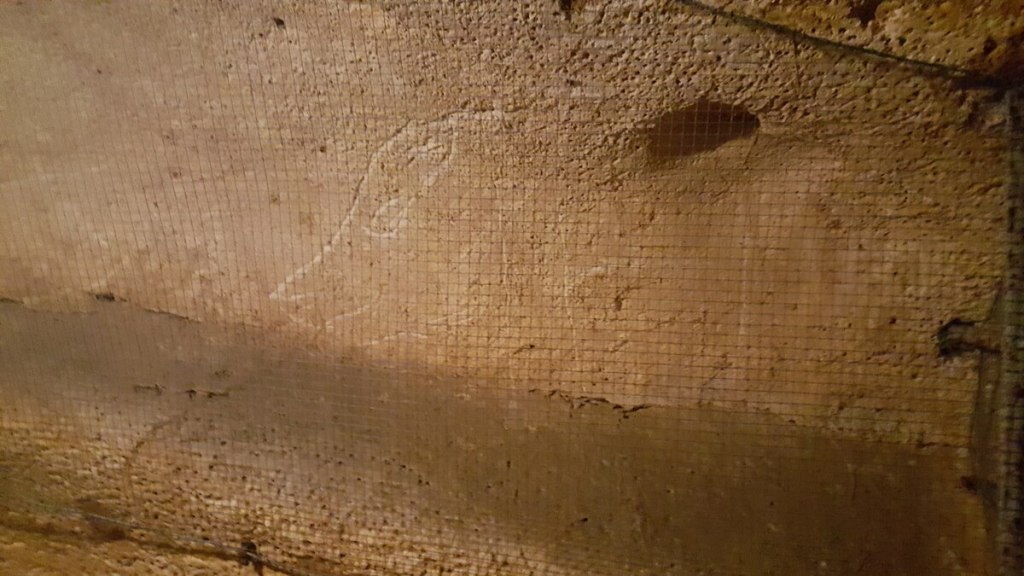
The Amédée Lemozi Prehistory Museum is next door to the Pech-Merle cave. Named for a French archaeologist, it displays recreations of many of the other nearby caves currently closed to the public. These images are from Grotte de Cougnac.

South of France trip: Saintes, Saint-Césaire, Les Eyzies, Font-de-Gaume cave, Lascaux, Les Combarelles, Pech-Merle caves, L’Aven d’Orgnac, Sarlot, Chauvet, Montpelier, Arles, Marseilles, Cosquer
Please do not download or reproduce images from this site. ©
Your comments are welcome!
Popular posts/stats/categories
Email me at: Ruth@RuthRosenfeld.com
Follow me on: Facebook Instagram BlueSky Blog
 Ruth Rosenfeld
Hi. It’s great that you were able to tour these caves. They are amazing.
LikeLiked by 1 person
Thanks. I couldn’t have done it without the tour – many are not open to individuals, and most need reservations way in advance. I was sure I would get lost driving around those little French towns alone. Yes, it was an amazing journey.
LikeLiked by 1 person
This is so amazing!
LikeLiked by 1 person
It truly is! I’m glad you are enjoying these posts, Diana.
LikeLiked by 1 person
These provide the viewer with a deep sense of unity and connection to our ancient ancestors.
LikeLiked by 1 person
It does make one realize that, although their lifestyle was different, they were like us. Thanks for reading, Jay.
LikeLiked by 1 person
These are incredible Ruth. I knew these caves must exist somewhere but didn’t know where. Now they are on my list to see myself. Again, I imagine Ayla being there 😊 Maggie
LikeLiked by 1 person
Yes, this was Ayla’s world. 😉 Glad to inspire you to look for yourself!
LikeLiked by 1 person
It must indeed have been very moving to almost touch hands with these ancient artists. Seeing those handprints emphasises the presence of the people behind the art.
LikeLiked by 1 person
Odd that these artists did not paint more realistic looking humans, as they have done with animals. The hands made me imagine that person standing there blowing (as is believed) pigment over their hand. It’s like a signature, or tag in modern terms. We know they were there.
LikeLiked by 1 person
Wow! 27,000 years ago is really quite something – and those hand prints are so special!
LikeLiked by 1 person
It is staggering to imagine life that long ago, and longer in some of the painted caves in the 30,000s. Those hands do make you feel a connection. Thanks for reading and your comment, Hannah!
LikeLike
It’s wonderful that these caves have been preserved. And it’s incredible to hear how old some of these paintings and etchings are. Those handprints are really neat.
LikeLiked by 1 person
Once it was realized that these were the works of prehistoric people, a effort was made by the government, local and national, as well as private owners, to carefully preserve them. I imagine the hands are like a signature of the artist, or marks from clan? tribe? people of the time.
LikeLiked by 1 person
What is it with exploring kids discovering these things? I guess we owe them a debt of gratitude!
LikeLiked by 1 person
It’s something for bored, rural kids to do! And we’re fortunate they do.
LikeLike
Happy New Year Ruth! I enjoy your blogs so much. I can live vicariously through your travels. I hope to see more this year.
LikeLiked by 1 person
Thank you, Carol! I’m so glad you enjoy this blog. I look forward to your comments. Have a good year.
LikeLike