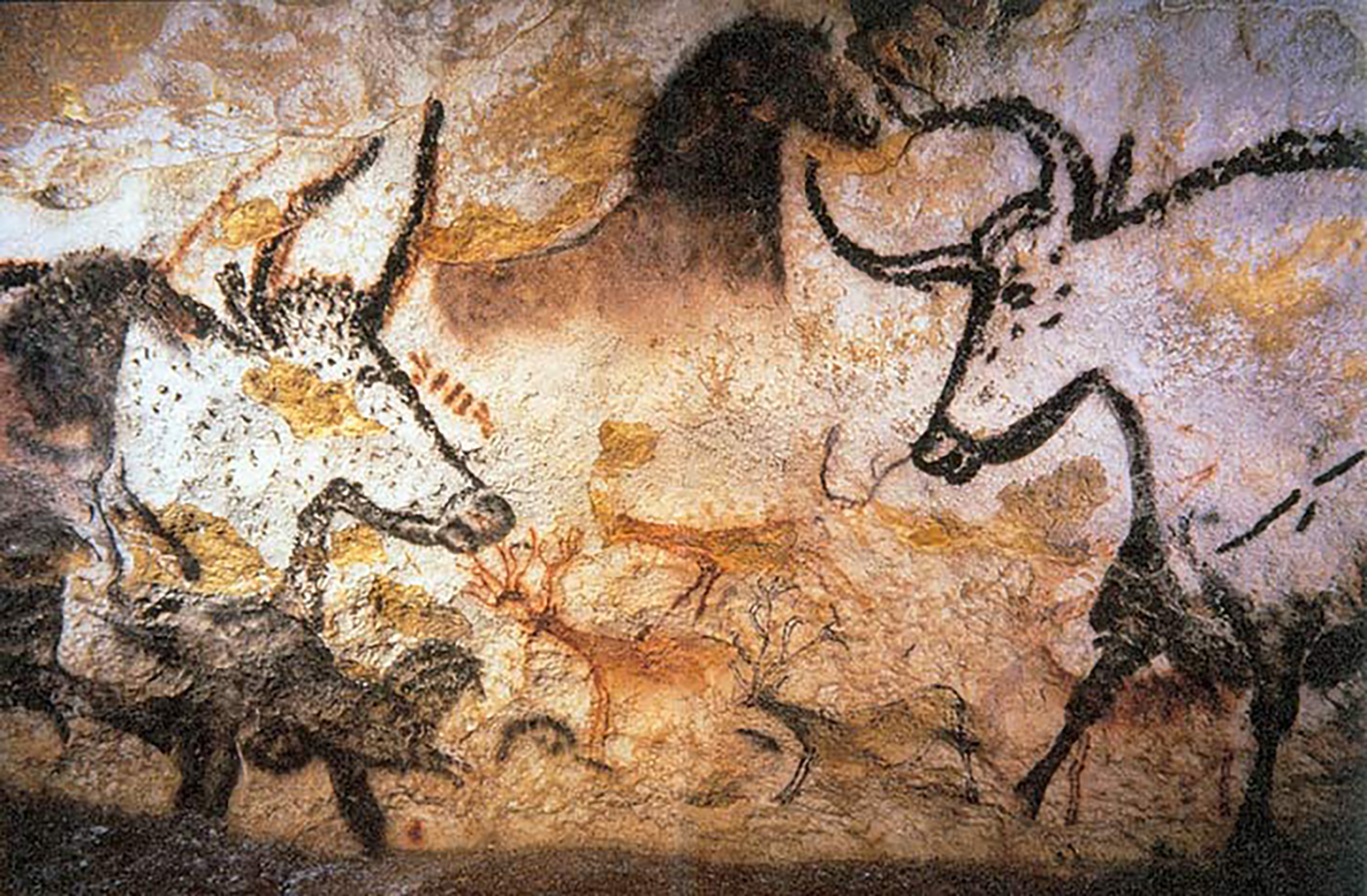
In 1940, four teenage boys and their dogs explored the grounds around the old Lascaux castle, in the Périgord region of France, looking for treasure. Robot, the dog, fell into a hole. They were able to rescue him, and could see there was an underground cave. The oldest, Marcel Ravidate, age 17, returned with some other boys a few days later with ropes and lamps. They held their dim lanterns down low to find their footing; after a while one lifted up his lamp. Paintings of horses and bulls covered the walls and ceiling! Having been sealed for thousands of years, the colors were vivid, brush strokes bold and strong. The boys danced in excitement, realizing they had found a greater treasure than they could have imagined.
Word soon reached Abbé Henri Breuil, who declared the prehistoric site was authentic. Breuil created detailed drawings copying the images over many visits. Ravidate became the caretaker of the cave until it was closed to the public in 1963. The original cave has been classified a UNESCO World Heritage Site and has been called the “Sistine Chapel of Prehistory” since it is felt to be the finest of the caves found to date in terms of color, size, quality, and quantity. Lascaux dates from 17,000 years ago, during the Magdalenian period, the same approximate time frame as Font-de-Gaume cave.

Over the decades Lascaux was open to visitors, contamination caused growth of algae that threatened the paintings. Several replicas have been made over time, at first showing partial areas of the cave. The current Lascaux IV claims to be an exact copy of the original. Modern technology has allowed the reproduction of walls shaped like the actual cave, and artists have meticulously replicated the images.
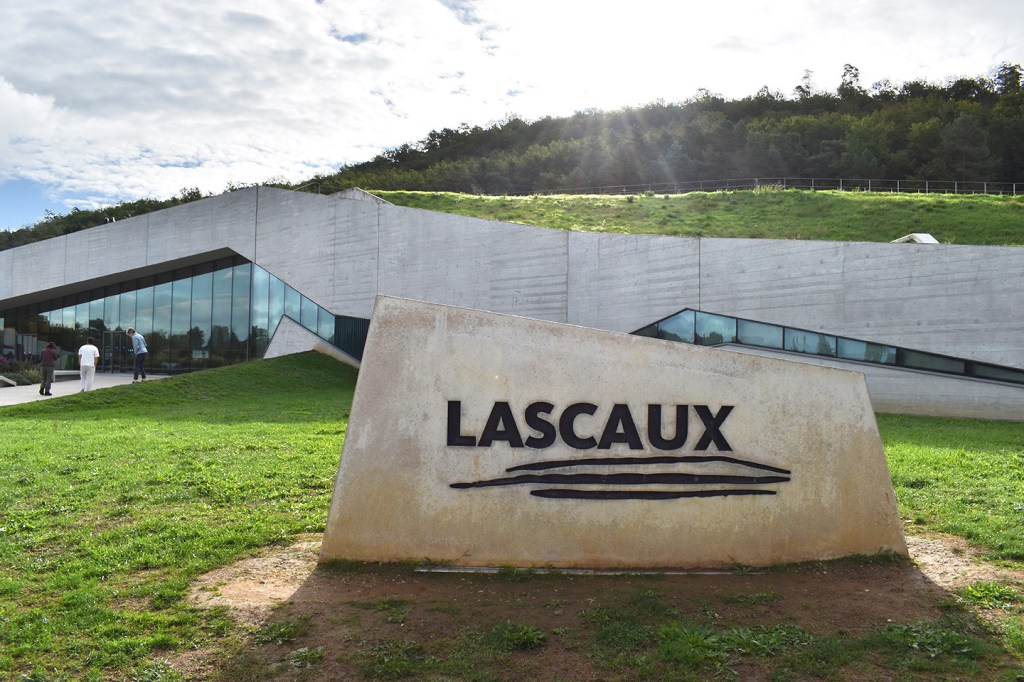
We walked down a ramp to the first section, well lit, and shining with painted animals in brilliant color. I gasped and felt my eyes tearing. My visit to Font-de-Gaume the day before had the feel of finding pictures in a stone cave, but this felt like a prehistoric art museum! The whiteness of calcite covering higher areas of the walls and roof in places made the colors more intense. The flowing lines, curved and sensitive, accurately and beautifully described the animals. The original artists used natural pigments either ground into powders and mixed with animal fat or directly applied to the cave walls using brushes made from animal hair. Minerals like ochre, hematite, and manganese created rich pigments of reds, yellows, browns, and blacks. We continued through the cave, in awe of the talent, the creativity, the mastery of these artists so long ago.
The cave extends 235 meters, about 770 feet, with ceilings up to 8 meters, 27 feet, high in places. Names have been given to the various caverns, including the Hall of the Bulls, the first area near the entrance, the Passageway, the Shaft, the Nave, the Apse, and the Chamber of Felines.
Note: I didn’t take photos in the caves. The following images are from Wikimedia Commons, an Internet source of photos in the public domain.

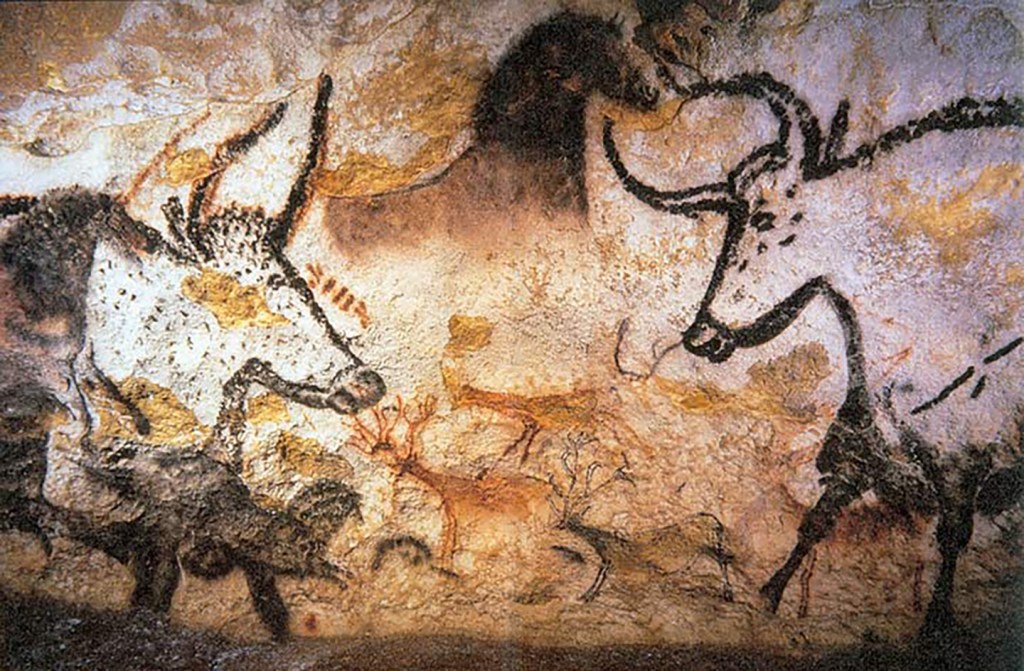
According to Wikipedia:
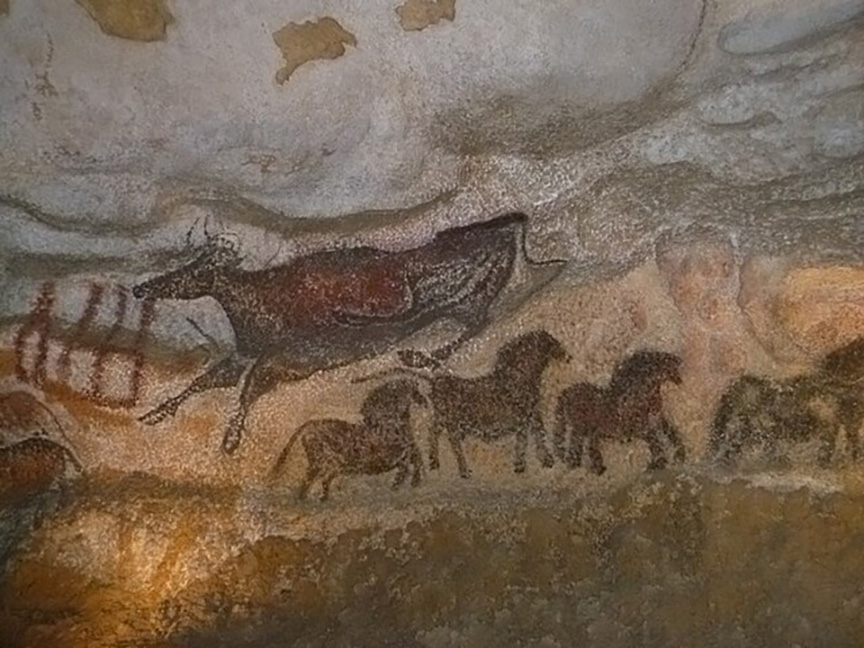
There are an estimated 6,000 paintings on the walls. Over 900 can be identified as animals, and 605 of these have been precisely identified. Out of these images, there are 364 paintings of equines as well as 90 paintings of stags. Also represented are cattle and bison, each representing 4 to 5% of the images. A smattering of other images includes seven felines, a bird, a bear, a rhinoceros. In the deepest reaches of the cave, at the bottom of a 9m-deep well, the only human figure of the cave was depicted.
Human figures were rare, although tracing of hands are in some caves, and are not as realistic as the animal images. In the Shaft, there is a six-foot wide image with a stick figure of a human with a bird head who seems to be falling backwards, a line nearby topped by a bird head, next to a bison who appears to have been speared. A spiritual myth illustrated? The story of a hunt? Dots, lines, grids, and other symbols are repeated in many caves.


Later that day, with visions of Lascaux animals dancing in my head, we continued on to nearby La Chapelle-aux-Saints to visit the Museum of the Neanderthal Man. The first burial of a Neanderthal man and almost complete skeleton was found in a cave there in 1908. The museum displays a replica of the skeleton, a timeline of human evolution, found artifacts, and information about Neanderthal lifestyle as far as is known.


South of France trip: Saintes, Saint-Césaire, Les Eyzies, Font-de-Gaume cave, Lascaux, Les Combarelles, Pech-Merle caves, L’Aven d’Orgnac, Sarlot, Chauvet, Montpelier, Arles, Marseilles, Cosquer
Please do not download or reproduce images from this site. ©
Your comments are welcome!
Popular posts/stats/categories
Email me at: Ruth@RuthRosenfeld.com
Follow me on: Facebook Instagram BlueSky Blog
 Ruth Rosenfeld
Wow – what an amazing experience to see the caves in person. To see and feel what our ancestors did while creating their images. Amazing. Thanks for sharing.
LikeLiked by 1 person
It was such a memorable, unique experience. Thanks so much for reading and your comment!
LikeLike
Those paintings are incredible Ruth, I can see why your eyes teared up. So good that they are protected and yet have a space that does it justice so everyone can get a sense of how amazing they are. Maggie
LikeLiked by 1 person
It was stunning to stand before these paintings. We are fortunate we have the techniques to preserve and even replicate this amazing site. Thanks for reading and your comments, Maggie.
LikeLiked by 1 person
Wow, what an amazing story and a find! This is undoubtedly a visit not to be missed! I had no idea that in France, there is a place where you can view the incredible prehistoric cave art created by our artistically-inclined ancestors many, many years ago. Thanks for sharing, and have a good day 🙂 Aiva xx
LikeLiked by 1 person
There are many sites, but this is such an exceptional treasure, it’s worth a visit, Aiva. Thanks for reading and your comment.
LikeLiked by 1 person
🥰🥰🥰
LikeLiked by 1 person
These findings affirm that France’s reputation for artistic expression is rooted in prehistory.
LikeLiked by 1 person
I don’t know if you can draw a direct line to modern day France, but your insight made me smile.
LikeLiked by 1 person
I remember hearing the story of the discovery of Lascaux while at school and marvelling that children around my own age had been the first to see after so many centuries! The museum with the reproduced paintings sounds excellent, almost as good as seeing the real thing (which of course has to be protected).
LikeLiked by 1 person
The don’t call it a museum, although it had the feel of such, it’s a reproduction of the entire cave environment. That’s as close as we can get! Glad to know this story was taught in school. It was not part of my art or history curriculum.
LikeLiked by 1 person
It was when we learned about early man in junior school I think
LikeLiked by 1 person
Gorgeous! I’ve been meaning to visit Lascaux for YEARS, but the opportunity never arose! Although it’s unfortunate that visitors can’t check out the original caves, it’s understandable the need to preserve the artwork from outside exposure; the replica looks fabulous and worth a visit! Very fascinating to learn more about pre-historic France and the early years of humankind. Thanks for sharing, Ruth!
LikeLiked by 1 person
It was certainly a learning experience for me, and as an art student and lover, it was a wonderful one. Thanks, Rebecca, for your comment!
LikeLiked by 1 person
Wow, I love the story of the discovery – what a brave 17 year old to go down there in the first place to explore. It’s a shame you can’t see the real thing, but it looks beautiful 🙂
LikeLiked by 1 person
Reproduction has been the process with several ones discovered in our more modern era. With the ability of technology these days, it has kept the feel of walking through a cave. As close as we can get! Thanks for reading and your comment, Hannah.
LikeLike
Wow, can you imagine stumbling onto something like that? Fascinating. I would love the Neanderthal Museum as well.
LikeLiked by 1 person
What an amazing, magical moment that would be!
LikeLiked by 1 person
Wow, this is so fascinating! I can’t imagine just accidentally stumbling upon that one day.
LikeLiked by 1 person
There are few explorers these days (space, bottom of the ocean?), but maybe a few more surprising hidden treasures!
LikeLiked by 1 person
It’s pretty amazing to hear how the cave and paintings have been reproduced and replicated. Sounds like a good solution to still showcase the paintings in a way that feels authentic.
LikeLiked by 1 person
One of the caves, Chauvet (blog to come), had videos showing how they were constructed and painted. Quite amazing! Thanks for reading and your comment.
LikeLiked by 1 person