
Picturesque Les Eyzies-de-Tayac-Sireuil, which calls itself the Center of Prehistory in Dordogne, France is surrounded by cliffs and rock formations, and is home to caves, shelters, and remains from tens of thousands of years and more in the past. It’s situated in the Vézère Valley, declared a UNESCO World Heritage Site in 1979.
Up above the town, against monochrome streaked cliffs, sits the Musée National de Préhistoire, National Prehistory Museum, known for its extensive collection of millions of Paleolithic items. Outside the building stands a sculpture of Neanderthal “Primitive Man” by French sculptor Paul Darde. On a morning visit to the museum, having a local tour guide was helpful, to learn about the many stone tools, bone and ivory carvings, skeletons of Neanderthals, and other artifacts.

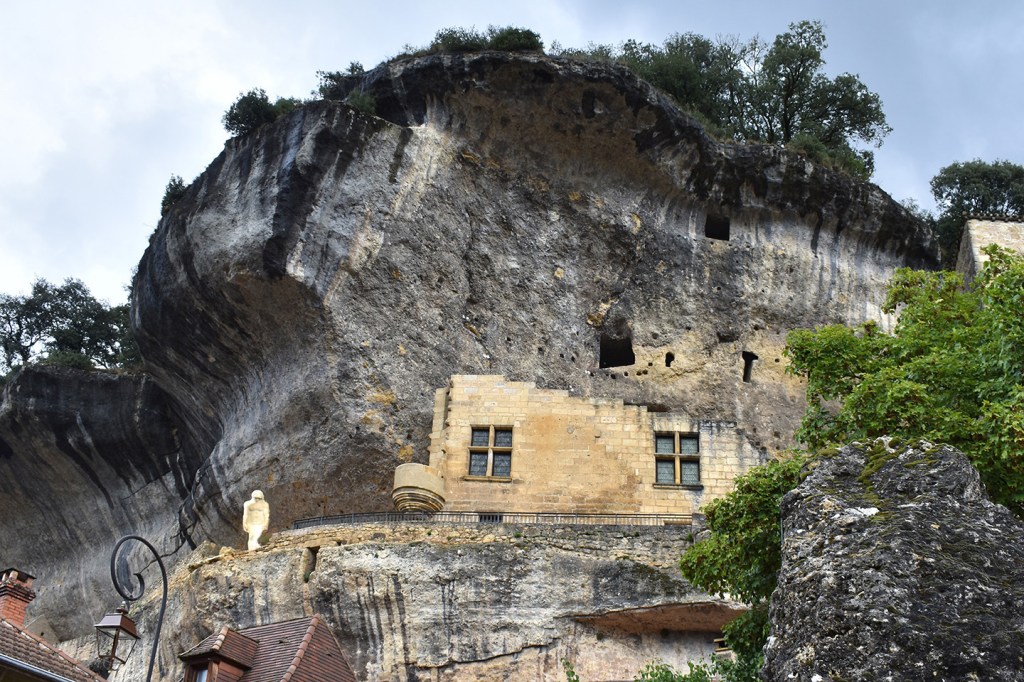

The long-awaited highlight of our first day there was Font-de-Gaume cave, the only cave in France with polychrome paintings still open to the public. Over five days, as we made our way across southern France, we would visit five painted caves. Three of the sites were caves that had been open to the air over time. The other two, although the largest, most dramatic and beautiful, are recreations, the originals being subject to rapid deterioration, having just been discovered and opened in recent times.
In Font-de-Gaume and many other natural caves in southern France and northern Spain, some of which are privately owned and not accessible, the drawings, paintings, etchings, and markings were aged over millennia and more difficult to discern. But it was fascinating to walk through the actual cave, squeeze through some narrow passages, observe the naturally curved rock walls in grays and browns, step over gratings placed by preservationists to protect the worn stone and gravel paths. The colors of the paintings were mostly iron oxide red browns and charcoal or manganese dioxide black. I was pleased that our first cave was a natural one, to get the feel of the environment in which the ancient artwork was created and walk in the actual footsteps of those early artists.
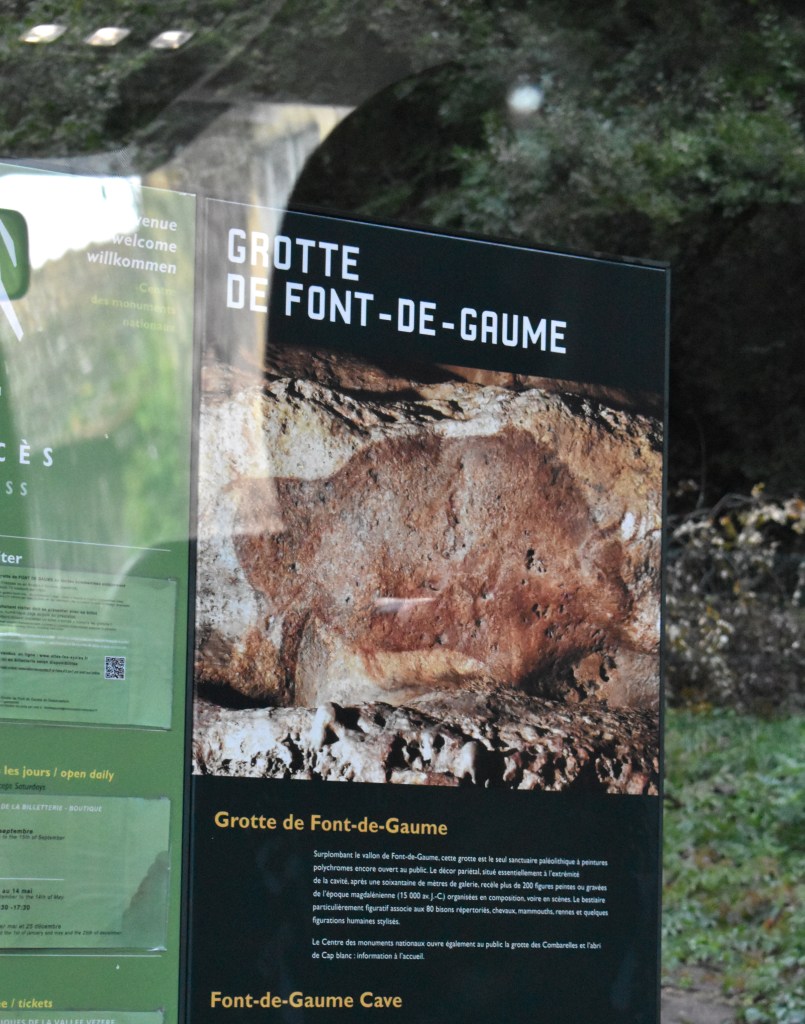
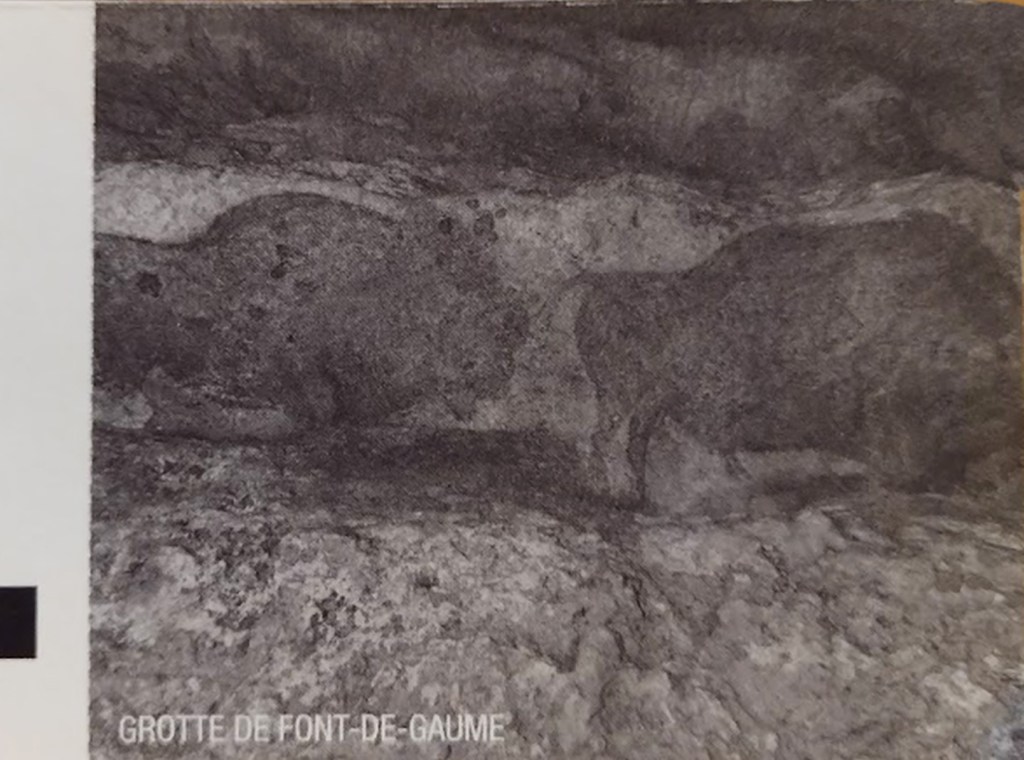
Tour guides used laser pointers to designate the outlines of the paintings, making them come alive to observers. Sections were dimly lit by floor lamps, turned on and off as we passed them. There are over 200 paintings and engravings in Font-de-Gaume dating from the Magdalena era, about 17,000 years ago (15,000 BCE). By far, most paintings were animals of the time: mammoth, reindeer, horses, bison, megaloceros, aurochs, lions, and cave bears. They were solitary figures or grouped, often drawn over other images, believed to be created at different times, perhaps by many different people. Some shapes of the animals followed the contours of the rock and appeared three-dimensional, running or leaping out of the wall.
Note: I didn’t take photos in the caves. The following images are from Wikimedia Commons, an Internet source of photos in the public domain.


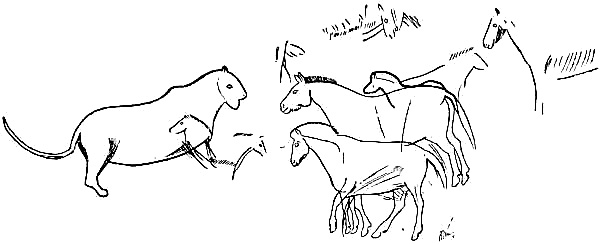
My excellent reference for this journey was The Cave Painters: Probing the Mysteries of the World’s First Artists, by Gregory Curtis, a journalist. I read it a year ago and was inspired to take this journey. The drawings below were done by Abbé Henri Breuil (1877–1961), whose detailed drawings extensively documented prehistoric cave art in France. The animals depicted on the cave walls generally just stand there, not in movement of any kind, however I was excited to see this notable exception. The first image of a painting shown in Curtis’ book was the first I saw, in this first cave, and one that most touched my heart. The male reindeer is bending down to lick the head of the kneeling female. It’s one of the most exquisite, expressive, and beautifully painted, with coloring, shading, and curved brush strokes. Tears came to my eyes as we stood there. One of our group asked, “Is it grooming? or aggression?” I added, “or love?”

Of course, no one can know the intentions of the artists, if the paintings were made for hunting ceremonies, spiritual reasons, art for art’s sake. Many of those theories were discussed by our tour guides and by Curtis, with credit to the originators of the theories and the arguments they had over decades. But looking at these paintings, you can feel the artist’s love of the craft, of the beauty and power of the beasts, and the intelligence behind the works, a moving connection to that person so long ago who was not so different from us.


Curtis describes looking out over the valley from the cliffs of Les Eyzies and imagining the huge, migrating herds that must have wandered and grazed across the landscape, back in the day when humans were few and animals owned the earth.
Recommended for further research

At La Ferrassie rock shelter, eight Neanderthal remains were found in the 20th century, including adults, children, infants, and even two fetuses. It was here that the largest and most intact Neanderthal skull ever recorded was found.

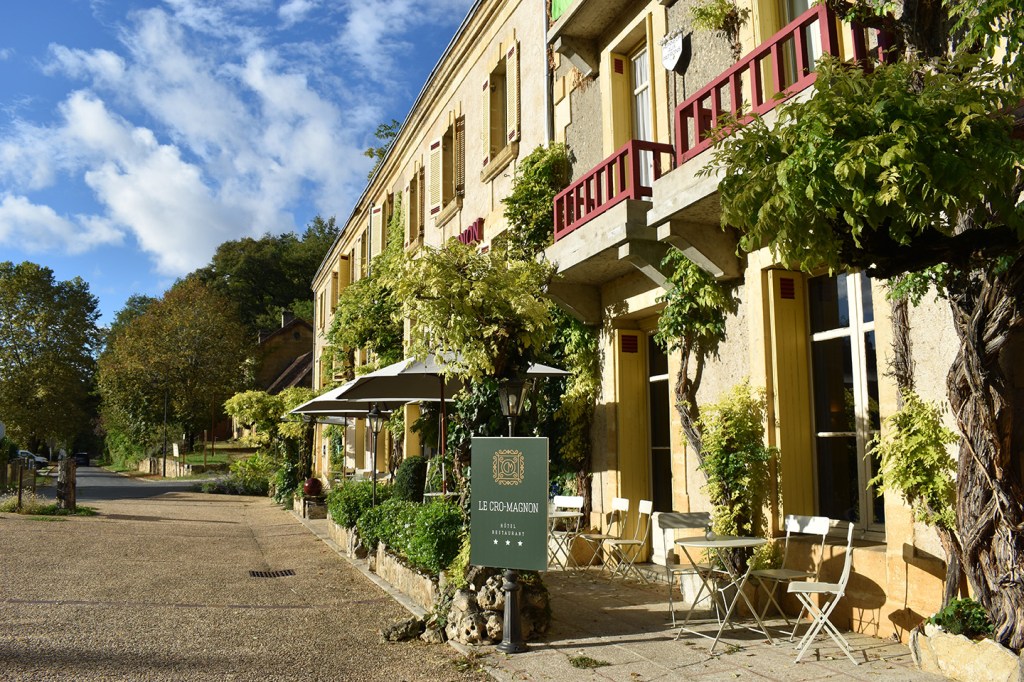
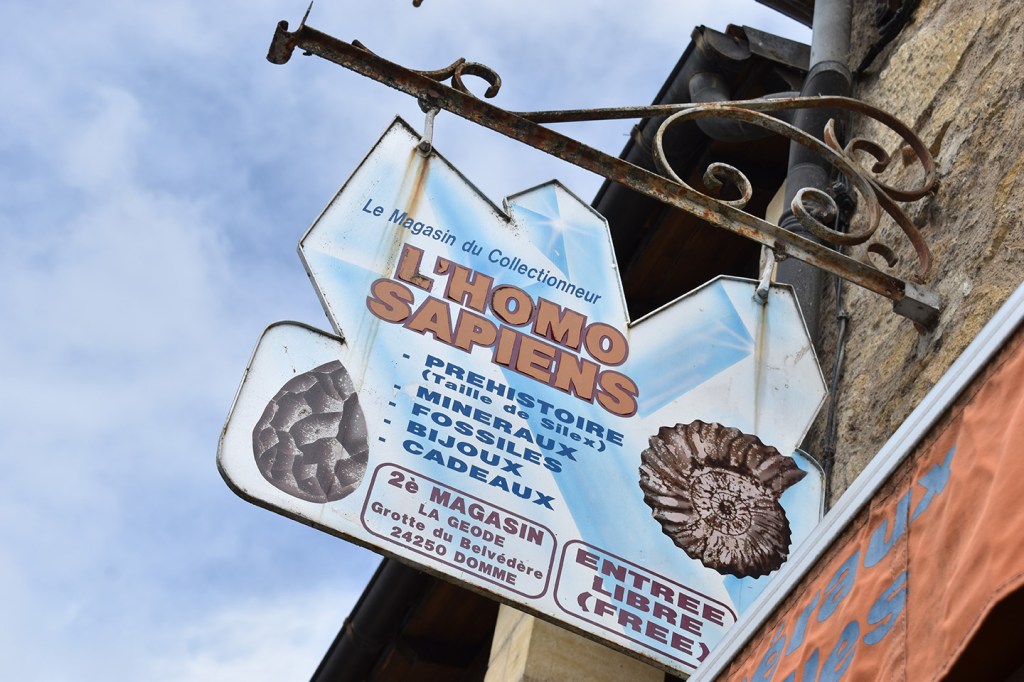
The town of Les Eyzies certainly celebrates its prehistoric claim to fame!



South of France trip: Saintes, Saint-Césaire, Les Eyzies, Font-de-Gaume cave, Lascaux, Les Combarelles, Pech-Merle caves, L’Aven d’Orgnac, Sarlot, Chauvet, Montpelier, Arles, Marseilles, Cosquer
Please do not download or reproduce images from this site. ©
Your comments are welcome!
Popular posts/stats/categories
Email me at: Ruth@RuthRosenfeld.com
Follow me on: Facebook Instagram BlueSky Blog
 Ruth Rosenfeld
Thanks Ruth for sharing your experience. It’s such a wondrous and special place.
LikeLiked by 1 person
These travels get to live again as I share them with you. Thanks for reading.
LikeLike
Thanks for a fascinating tour.
I’d forgotten, or maybe didn’t know, that lions once were in Europe, including, eventually, “modern “ lions.
LikeLiked by 1 person
Thanks for reading, Neil! I’ve seen them referred to as cave lions. They didn’t have manes.
LikeLiked by 1 person
Hi. Wikipedia says that what we know as today’s lion also used to be in Europe, becoming extinct there maybe between 500AD and 1000AD.
LikeLiked by 1 person
Interesting! There’s so much to learn.
LikeLiked by 1 person
The paintings are much more detailed and skilled than I has expected. It must have been such a thrill Ruth. It makes me think of the Clan of the Cave Bear books. Have you read any? Maggie
LikeLiked by 1 person
It was truly thrilling, eye-opening and mind changing, Maggie. I read the first book long ago, and then read it online again towards the end of this trip with the second book, which I didn’t like as much. Then I looked online to see what the others were in the series and the last, #6, is The Land of Painted Caves! So I ordered it and read it!
LikeLike
It was the Painted Caves that I thought of the most I think, but it’s been a few years and the books have melted into one in my head. 😊
LikeLiked by 1 person
It was good to reread the first book as well because it is about Neanderthals and the author’s ideas about their differences from us.
LikeLiked by 1 person
Brings back good memories. Our family did a walking trip in the Dordogne back in May of 2001 (my son was 12 at the the time). We visited Font-de_Gaume. The cave art is amazing, it makes us question so many of our preconceived notions about art and its importance.
LikeLiked by 1 person
A walking trip would be lovely in that area. I’m sure visiting the cave was an exciting discovery for your son at that age! Thanks so much for your thoughtful comment. It appears art was important to those people in their lives as well. I imagine they probably had many other creative outlets that haven’t survived. So many things to think about.
LikeLiked by 1 person
Walking is a great way to explore that area. It slows you down and you see what life in that area is really like (including some very impressive amounts of mud after rainfall).
LikeLiked by 1 person
😄
LikeLiked by 1 person
These images are truly works of art and not the primitive line sketches we imagine that our prehistoric ancestors etched out.
LikeLiked by 1 person
Although we may consider their lifestyle more primitive, their art shows expressiveness, skill and subtlety. Thanks for reading.
LikeLiked by 1 person
What a wonderful place to visit, the art is really quite detailed and skilled. Beautiful.
LikeLike
Thanks, Hannah. It was amazing to see that ancient art.
LikeLike
This was clearly such a fascinating trip, and being able to enter and walk through a cave with so much human history sounds like a very special experience. That painting of the male and female reindeers is truly beautiful and it seems to draw a line linking those very early people to us today, showing us that art is something that we have in common. It also made me reflect how that’s true of our different present-day races, when there are so many who want to emphasise, or even create, differences between us.
LikeLiked by 1 person
I suppose throughout history there have always been those who are divisive. But this journey made me feel the connections between us and those early people. It was certainly a special experience. Thanks, Sarah, for reading and your comment.
LikeLiked by 1 person
It’s impressive how many paintings there are and that they’re from 17,000 years ago. I can’t even wrap my head around that.
LikeLiked by 1 person
Our early ancestors loved art in their own way. One of the caves I went to was almost twice that long ago!
LikeLiked by 1 person
Very fascinating! I’ve only heard of the cave paintings in Lascaux (inaccessible to the public nowadays), but I haven’t heard of Font-de-Gaume…it looks like a great alternative to Lascaux, to view the enigmatic paintings inside and to wonder at the history of mankind thousands of years ago. Thanks for sharing your adventures here, Ruth!
LikeLiked by 1 person
My next post is Lascaux, although the original cave is closed, there is a remarkable recreation. There are many of these caves like Font-de-Gaume, not as famous but still fascinating to see. Thanks, Rebecca, for reading and your comment!
LikeLiked by 1 person
Your love of art really comes through in this post. It’s amazing to me not just how old the art is, but that they can determine that it’s that old!
LikeLiked by 1 person
Thanks so much! There are many new dating techniques, it’s quite amazing. They can tell the difference between different color materials they used, can compare them to growth on the surrounding walls, and even determine the order in which overlapping images were painting.
LikeLiked by 1 person